Showing posts with label old testament. Show all posts

Nov 17, 2009

Amos' Parade of Nations


The first part of Amos is a series of oracles against the nations surrounding Israel. My professor asked me this follow-up question on my previous post summarizing Amos: What is the significance of the geographical ordering of the nations mentioned in the prologue of Amos? I've been doing some research, but couldn't find any straight-forward answer in wikipedia's article on Amos, nor the Catholic Encyclopedia article on Amos, nor a lengthy commentary on Amos. So I'm going with my own crazy(?) idea ...

Amos first mentions Aram, a name also given to a grandson of Noah. He then mentions Gaza and Tyre. Next is Edom, a name also given to Esau - Jacob's twin brother. He finally mentions Ammon and Moab which are also names of descendants of Lot - Abraham's newphew. So, with the exception(?) of Gaza and Tyre, all of the nations Amos mentions are etiologically related to Israel. It makes for a powerful rhetoric to draw his audience into the saga and drama of their own "relatives." Or, it might just be a simple effect of writing the patriarchal history from the context of the lands and peoples of Palestine, if that's indeed what happened.

Another idea I couldn't verify from research is that the order of the nations may be the order in which Assyria conquered them? If that's the case, it would support the idea that Amos may have been a post-exilic writing. Although, Assyria conquered Israel before Judah.

Anyone else have an idea? I'm dying to know ...

Nov 9, 2009

Amos


I'm going to jump-start mixing blogging and theology by doing this week's Old Testament homework in a blog post. We're reading Amos, and tonight I'm specifically re-reading Amos to summarize three portions of Amos - his judgement of Israel, his three woes, and his vision. First a little context ...

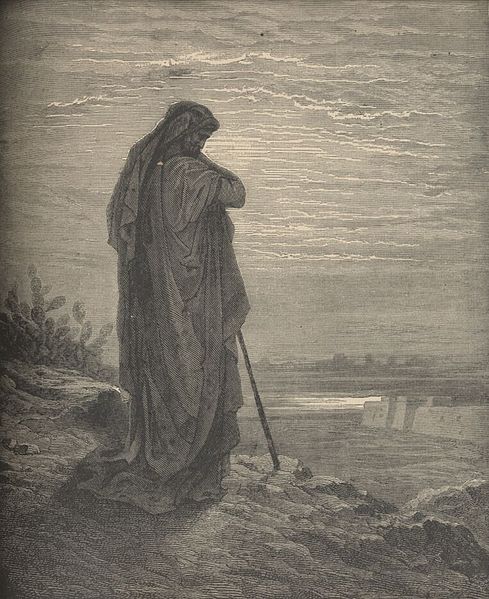
Amos was not a professional prophet. He was a farmer from Judah in the south, called to prophecy in Israel in the north. He was active in the 8th century BC, probably around 760-745. All around Israel, Assyria was the world super-power - gaining land and tributaries all over Mesopotamia from Babylon to Syria. (I know, Assyria vs. Syria is confusing.) Amos preached when a "weak" king ruled Assyria, so Israel still enjoyed independence and prosperity and did not face immediate threat of invasion. As such, Israel (and Judah) fell into a listless lifestyle and culture that ignored or forgot Yahweh and the responsibilities of His covenant.

Into this, Amos starts his preaching in a formula on the evils of the other nations around them - Aram, Philistia, Tyre, Edom, Ammon, and Moab. "Thus says the LORD: For three crimes of _____, and for four, I will not revoke my word;" In the blank, he names the nation or its capital city. After this, he names specific evil of the nation - e.g., "Because they threshed Gilead with sledges of iron" or "Because they took captive whole groups to hand over to Edom" etc. He then pronounces the punishment of each in the form "I will ... (send fire, root them out, turn my hand against them, etc.)" You can almost hear the shouts of "Amen!" and "Preach it!" and "Glory to God!" from his audience like you might hear in a contemporary fiery sermon of judgement.

Then he throws a curve ball. He continues right on in the formula judging against Judah! Of course his audience is in Israel, so they probably gave some mild awkward applause for his judgment against Judah: "Because they spurned the law of the LORD, and did not keep his statutes; Because the lies which their fathers followed have led them astray." (2:4) Well sure - the Davidic monarchy was known to be in error, right? So of course Judah's fathers led them astray. Okay then, getting too close to home, probably about time to wrap it up, right?

Then he blows their minds; hammers into Israel with his most scathing judgement: "Because they sell the just man for silver, and the poor man for a pair of sandals. They trample the heads of the weak into the dust of the earth, and force the lowly out of the way. Son and father go to the same prostitute, profaning my holy name. Upon garments taken in pledge, they recline beside any altar; And the wine of those who have been fined they drink in the house of their god." (2:7-8) Ouch. Say what now?

The first major theme of Amos's judgement against Israel is perfectly summarized by our textbook: "He [Amos] connects the injustice he sees around him to a society bent on wealth and prosperity and forgetful of the true worship of God." Ouch again - sound familiar?

Secondly, Amos, like all the prophets, condemns Israel's idolatry to "any altar" - referring to the widespread worship of the gods of Canaan by the Israelites. This offense is compounded with mistreatment of the poor, who would give their cloaks as pledges to their creditors, who were supposed to return them before nightfall ("If you take your neighbor's cloak as a pledge, you shall return it to him before sunset; for this cloak of his is the only covering he has for his body. What else has he to sleep in? If he cries out to me, I will hear him; for I am compassionate." Ex 22:25-26, also Dt 24:12) Amos goes on to reiterate Yahweh's supremacy over Israel as opposed to other gods, and gives a strong premonition of military defeat.

Another major part of Amos's preaching are three woes. I had to look up the biblical meaning of 'woe' and I think it roughly means the opposite of blessings - i.e., disasters. Amos speaks a first woe - that Israel will not live in its houses nor drink of its vineyards because they "turn judgment to wormwood and cast justice to the ground." The second woe is, ironically, to those who long for "the day of the LORD" - Amos preaches it will be a day of darkness for Israel and not light, because Israel makes empty offerings and songs. For this, Amos preaches that Yahweh will "exile [them] beyond Damascus." Finally, Amos decrees the woe that a nation (Assyria) will oppress Israel for its complacency in trusting in its wealth and military might and not in Yahweh.

Amos also relates symbolic visions - threats and promises - to Israel. First a vision of locusts and then of fire (burning drought) destroying Israel, at each of which Amos intercedes for Israel and Yahweh repents of it. Then he has a vision of a plummet - specifically, of God using one to judge the uprightness of Israel. Against this Amos does not intercede. Amos also has a vision of a basket of ripe fruit, which I'll admit completely dumbfounds me as to its meaning. Finally, Amos has a vision of the destruction and total ruin of an altar and temple killing those inside; symbolizing that no-one escapes God's punishment.

That's all the homework I'll post for now. I also picked out three instances of three kinds of parallelism found in Amos, but that would take this post into Hebrew poetry which is way to deep to cover fairly. :)

Sep 28, 2009

(optional) contextivism !== relativism


Hypocrisy, thy name is Luke. Here's some of my own theological activism/contextivism not an hour after I wrote about disliking it. This is an optional rant post. I've tried to stay away from ranting on this blog, but in this case I just need to vent. Feel free to skip this ...

Remember I said one of the theological discussions/debates to which I'm drawn is the whole evolution/creation/Genesis thing? Well, I had been in just such a discussion over on imonk with this "Will" guy. I brought up the parallel to the Galileo affair, and he wanted to take that on.

The main meat of our exchange starts here. I'll wait while you catch up on at least that much.

Done? Good. Normally I would have commented back again, but imonk very smartly closes comments on posts older than 6 days, and I was too busy bringing my newborn daughter home from the hospital to comment in that time. That's mostly why we're getting into it here.

His last comment is the worst offense, and I really hate that it will be the last word in the dialog for anyone who stumbles onto it later. Oh well. Here's what he said:

Where does it stop Luke? What if science one day provides evidence that resurrections don’t happen. Do we need to stop with the black and white thinking that requires a literal resurrection?

Oh….wait. Science does show clearly (one heck of a lot clearer than it does show evolution) that humans that are truly dead for 3 days don’t come back to life. How can we reconcile this without becoming the closed minded church of Galileo? Maybe the resurrection was metaphor. Maybe the ancients didn’t really care about a real literal resurrection. Maybe they just cared about hope coming out of disappointment.

What? Are you arguing with me? Why are you being so closed minded about things. We all know that the dead don’t literally rise. Don’t we? The sooner Christians stop clinging to silly notions such as this the sooner we can have a genuine faith.

Or…..we could believe what scripture says and let science catch up later. Your choice my friend.


This is a classic slippery slope fallacy. It seems common among scientists, engineers (like me), and fatalists. Basically, Will is saying that if we reason that Genesis 1-3 is myth rather than literal Truth, we will inevitably be forced into sacrificing our faith in Jesus Christ to reason. It just doesn't work that way for me. Maybe it works that way for Bill G (if he's still reading this blog)? It's a similar string of logic: observe that the authorship or accuracy of text in the Bible is uncertain, and be inevitably forced to conclude that the whole Bible is myth. I just can't connect all those dots.

Back to Will's particular statement about resurrection. A similar thought came up in class as well, and I'll ask it here: is there any way science (archaeology was the science in question) could void your faith?

In that particular discussion, I had to admit yes. If I'm someday convinced that we have uncovered the tomb and remains of Jesus, that would shake and uproot my faith. I would have to more seriously consider Judaic and/or Islamic traditions. It's somewhat unpleasant thought, but I have to admit it to myself out of intellectual honesty.

So here's the point: I used to feel that way about evolution, but I don't anymore. And the key for me is context. The context of Genesis 1-3 within the Pentateuch, the Old Testament, the Jewish and Christian traditions - means evolution just doesn't amount to a faith-changing notion for me. But I understand completely where Will is at right now. When my faith was "the entire Bible is literally true as read in my own interpretation," then believing evolution would have been a faith-changing event for me. But when I rejected sola (my) scriptura, it suddenly became a non-issue.

But the key for me has always been about context. I just get really irked when people confuse contextualization with total relativism - i.e., either you ignore all context and take everything directly at face value, or else you have to concede everything you think to be True is totally relative.

Sep 9, 2009

Genesis

I just got home from my 3rd class of Old Testament Literature. I'm loving the class - great textbook, great teacher, great school and setting (we have our classes at the chancery of the Tulsa Diocese).

I've always struggled with reading the Old Testament; I don't think I've ever approached it with a good context. And the first couple of classes did precisely that - focused on history, geography, languages, and cultures of the ancient near east. It's incredibly helpful to know the setting - it's the difference between watching a movie from the beginning and catching it anachronistically in 10- or 15-minute clips.

Here's some general ideas about the Old Testament, stop to think how controversial they seem to you. (I'm not going to say if I believe all of these or not, just think about them.)

  • There are many passages that copy older religious texts from Babylon, Assyria, Egypt, and other ancient near eastern cultures.

  • The Pentateuch (first 5 books) was NOT written down by Moses.

  • There are duplications and contradictions in the text.

  • Genesis is a mix of myth, legend, and saga - not literal history.


Let me talk just a bit about that last one, since that's what we talked most about tonight.


So, jumping right in, Genesis can be roughly divided into Genesis 1-11 and Genesis 12-50. Gen 1-11 is "primeval" history; the story of what happened before history - before people began recording what was happening. This seems to be a spot where lots of Christians get themselves into trouble. This isn't an historical record nor a science textbook; it wasn't written as such, and I don't believe it should be received as such.

Does that mean it isn't true? No, of course not. But it's like Tolkien says:
There are truths that are beyond us, transcendent truths, about beauty, truth [itself], honor, etc. There are truths that man knows exist, but they cannot be seen - they are immaterial, but no less real, to us. It is only through the language of myth that we can speak of these truths.

In light of this, the Truth of Genesis 1-11 may not be that a talking snake seduced a man and woman in a Utopian garden, nor that a global flood killed every creature on the earth except for those which were loaded in pairs (or 7 pairs?) onto a big boat. Because similar myths are in fact prevalent in Babylonian and Assyrian texts which pre-date Genesis by a long time. God uses the myths of Adam & Eve, Cain & Abel, Noah & the Ark, and the Tower of Babylon to speak the Truth of His preeminence and creativity, His transcendence and intimacy, His righteousness, justice, and mercy. These attributes of God are altogether unique to Genesis in contrast to the chaotic, superficial, very human-like gods of the other ancient near eastern cultures.

And that's the Truth you have to establish if you're going to tell the Patriarch sagas in Genesis 12-50. God picks Abram, seemingly at random, from among the Hebrews and calls him especially out - to depart from Ur and the rest of his people. He promises land and progeny.

Abraham answers God's call, but that's about as much as you can say for him - he offers his wife on 2 separate occassions to be had by a foreign king, he doubts God's promise and impregnates a slave girl, he exiles his own son by that slave girl. Of course, to his ultimate credit and at the pinnacle of his story, he is faithfully willing to offer his son Isaac to God.

Isaac is a pretty small character in Genesis; he seems to mainly serve as an eponymous bridge from Abraham to Jacob. Though he does manage the same trick of offering his wife to the same foreign king to whom his father did.

Jacob is a freaking mess. He tricks his brother out of his birthright, then tricks his father and his brother out of the patriarchal blessing. For his trouble, he has a personal exile back to distant family and falls in love with a young daughter, the father of whom demands, as payment, 7 years of service and then tricks Jacob into marrying the older daughter instead and demands ANOTHER 7 years of service for the younger daughter. He stays for a while, tricks his father-in-law into giving him a large number of his livestock, then decides to sneak back to his home land with his wives and their children. The younger wife steals some possessions of her father and conceals them when he catches up with them to demand them back. They make a pact and go their separate ways.

I had to ask my teacher about all this because honestly, the patriarchs are really quite shifty relative to our idea of 'Godly' people. Without naming names, I'll just mention that the 'heroes' of the sagas of Israel, at various times engage in or attempt: fratricide, sex outside of marriage, polygamy, incest, deception and fraud ... the list goes on.

Eventually Jacob is renamed Israel by God, and his, really all the Patriarchs', story is redeemed by his son Joseph - really the only character in all of Genesis whom I can personally admire and would seek to imitate. He's the one with the fancy coat and the interpretation of dreams; sold into slavery, taken to Egypt, rises to become Pharoah's right-hand-man and eventually uses his position to enact a grandiose scheme of reconciliation with his brothers and father, thru which he coincidentally brings all the 12 brothers - whose names just happen to be the names of the 12 tribes of Israel - down from Palestine into Egypt under the Pharoah.

Curtain. End of Act 1. Act 2 is Exodus.

Seriously, if the primeval history of Genesis (1-11) speaks the transcendent Truth of God's divine nature, the patriarchal history of Genesis (12-50) speaks, very loudly, the very imminent truth of a very flawed human nature living out under that divinity.

Taken in context, it seems obvious that Genesis is meant largely as a preamble to Exodus. So, here's my question that my instructor intentionally left open to me:

How much, and which parts, of Genesis is myth, legend, saga, and/or historical fact?