 I've always struggled with reading the Old Testament; I don't think I've ever approached it with a good context. And the first couple of classes did precisely that - focused on history, geography, languages, and cultures of the ancient near east. It's incredibly helpful to know the setting - it's the difference between watching a movie from the beginning and catching it anachronistically in 10- or 15-minute clips.
Here's some general ideas about the Old Testament, stop to think how controversial they seem to you. (I'm not going to say if I believe all of these or not, just think about them.)
- There are many passages that copy older religious texts from Babylon, Assyria, Egypt, and other ancient near eastern cultures.
- The Pentateuch (first 5 books) was NOT written down by Moses.
- There are duplications and contradictions in the text.
- Genesis is a mix of myth, legend, and saga - not literal history.
Let me talk just a bit about that last one, since that's what we talked most about tonight.
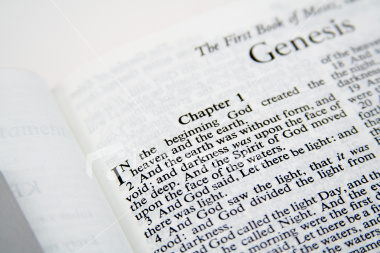
So, jumping right in, Genesis can be roughly divided into Genesis 1-11 and Genesis 12-50. Gen 1-11 is "primeval" history; the story of what happened before history - before people began recording what was happening. This seems to be a spot where lots of Christians get themselves into trouble. This isn't an historical record nor a science textbook; it wasn't written as such, and I don't believe it should be received as such.
Does that mean it isn't true? No, of course not. But it's like Tolkien says:
There are truths that are beyond us, transcendent truths, about beauty, truth [itself], honor, etc. There are truths that man knows exist, but they cannot be seen - they are immaterial, but no less real, to us. It is only through the language of myth that we can speak of these truths.
In light of this, the Truth of Genesis 1-11 may not be that a talking snake seduced a man and woman in a Utopian garden, nor that a global flood killed every creature on the earth except for those which were loaded in pairs (or 7 pairs?) onto a big boat. Because similar myths are in fact prevalent in Babylonian and Assyrian texts which pre-date Genesis by a long time. God uses the myths of Adam & Eve, Cain & Abel, Noah & the Ark, and the Tower of Babylon to speak the Truth of His preeminence and creativity, His transcendence and intimacy, His righteousness, justice, and mercy. These attributes of God are altogether unique to Genesis in contrast to the chaotic, superficial, very human-like gods of the other ancient near eastern cultures.
And that's the Truth you have to establish if you're going to tell the Patriarch sagas in Genesis 12-50. God picks Abram, seemingly at random, from among the Hebrews and calls him especially out - to depart from Ur and the rest of his people. He promises land and progeny.
Abraham answers God's call, but that's about as much as you can say for him - he offers his wife on 2 separate occassions to be had by a foreign king, he doubts God's promise and impregnates a slave girl, he exiles his own son by that slave girl. Of course, to his ultimate credit and at the pinnacle of his story, he is faithfully willing to offer his son Isaac to God.
Isaac is a pretty small character in Genesis; he seems to mainly serve as an eponymous bridge from Abraham to Jacob. Though he does manage the same trick of offering his wife to the same foreign king to whom his father did.
Jacob is a freaking mess. He tricks his brother out of his birthright, then tricks his father and his brother out of the patriarchal blessing. For his trouble, he has a personal exile back to distant family and falls in love with a young daughter, the father of whom demands, as payment, 7 years of service and then tricks Jacob into marrying the older daughter instead and demands ANOTHER 7 years of service for the younger daughter. He stays for a while, tricks his father-in-law into giving him a large number of his livestock, then decides to sneak back to his home land with his wives and their children. The younger wife steals some possessions of her father and conceals them when he catches up with them to demand them back. They make a pact and go their separate ways.
I had to ask my teacher about all this because honestly, the patriarchs are really quite shifty relative to our idea of 'Godly' people. Without naming names, I'll just mention that the 'heroes' of the sagas of Israel, at various times engage in or attempt: fratricide, sex outside of marriage, polygamy, incest, deception and fraud ... the list goes on.
Eventually Jacob is renamed Israel by God, and his, really all the Patriarchs', story is redeemed by his son Joseph - really the only character in all of Genesis whom I can personally admire and would seek to imitate. He's the one with the fancy coat and the interpretation of dreams; sold into slavery, taken to Egypt, rises to become Pharoah's right-hand-man and eventually uses his position to enact a grandiose scheme of reconciliation with his brothers and father, thru which he coincidentally brings all the 12 brothers - whose names just happen to be the names of the 12 tribes of Israel - down from Palestine into Egypt under the Pharoah.
Curtain. End of Act 1. Act 2 is Exodus.
Seriously, if the primeval history of Genesis (1-11) speaks the transcendent Truth of God's divine nature, the patriarchal history of Genesis (12-50) speaks, very loudly, the very imminent truth of a very flawed human nature living out under that divinity.
Taken in context, it seems obvious that Genesis is meant largely as a preamble to Exodus. So, here's my question that my instructor intentionally left open to me:
How much, and which parts, of Genesis is myth, legend, saga, and/or historical fact?


