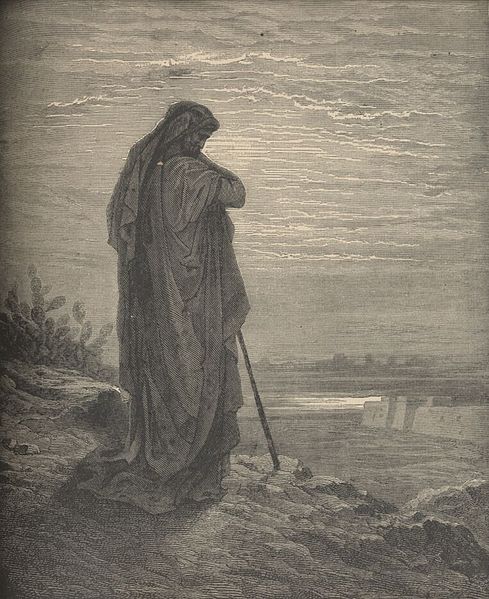
I'm going to jump-start mixing blogging and theology by doing this week's Old Testament homework in a blog post. We're reading Amos, and tonight I'm specifically re-reading Amos to summarize three portions of Amos - his judgement of Israel, his three woes, and his vision. First a little context ...
 Amos was not a professional prophet. He was a farmer from Judah in the south, called to prophecy in Israel in the north. He was active in the 8th century BC, probably around 760-745. All around Israel, Assyria was the world super-power - gaining land and tributaries all over Mesopotamia from Babylon to Syria. (I know, Assyria vs. Syria is confusing.) Amos preached when a "weak" king ruled Assyria, so Israel still enjoyed independence and prosperity and did not face immediate threat of invasion. As such, Israel (and Judah) fell into a listless lifestyle and culture that ignored or forgot Yahweh and the responsibilities of His covenant.
Into this, Amos starts his preaching in a formula on the evils of the other nations around them - Aram, Philistia, Tyre, Edom, Ammon, and Moab. "Thus says the LORD: For three crimes of _____, and for four, I will not revoke my word;" In the blank, he names the nation or its capital city. After this, he names specific evil of the nation - e.g., "Because they threshed Gilead with sledges of iron" or "Because they took captive whole groups to hand over to Edom" etc. He then pronounces the punishment of each in the form "I will ... (send fire, root them out, turn my hand against them, etc.)" You can almost hear the shouts of "Amen!" and "Preach it!" and "Glory to God!" from his audience like you might hear in a contemporary fiery sermon of judgement.
Then he throws a curve ball. He continues right on in the formula judging against Judah! Of course his audience is in Israel, so they probably gave some mild awkward applause for his judgment against Judah: "Because they spurned the law of the LORD, and did not keep his statutes; Because the lies which their fathers followed have led them astray." (2:4) Well sure - the Davidic monarchy was known to be in error, right? So of course Judah's fathers led them astray. Okay then, getting too close to home, probably about time to wrap it up, right?
Then he blows their minds; hammers into Israel with his most scathing judgement: "Because they sell the just man for silver, and the poor man for a pair of sandals. They trample the heads of the weak into the dust of the earth, and force the lowly out of the way. Son and father go to the same prostitute, profaning my holy name. Upon garments taken in pledge, they recline beside any altar; And the wine of those who have been fined they drink in the house of their god." (2:7-8) Ouch. Say what now?
The first major theme of Amos's judgement against Israel is perfectly summarized by our textbook: "He [Amos] connects the injustice he sees around him to a society bent on wealth and prosperity and forgetful of the true worship of God." Ouch again - sound familiar?
Secondly, Amos, like all the prophets, condemns Israel's idolatry to "any altar" - referring to the widespread worship of the gods of Canaan by the Israelites. This offense is compounded with mistreatment of the poor, who would give their cloaks as pledges to their creditors, who were supposed to return them before nightfall ("If you take your neighbor's cloak as a pledge, you shall return it to him before sunset; for this cloak of his is the only covering he has for his body. What else has he to sleep in? If he cries out to me, I will hear him; for I am compassionate." Ex 22:25-26, also Dt 24:12) Amos goes on to reiterate Yahweh's supremacy over Israel as opposed to other gods, and gives a strong premonition of military defeat.
Another major part of Amos's preaching are three woes. I had to look up the biblical meaning of 'woe' and I think it roughly means the opposite of blessings - i.e., disasters. Amos speaks a first woe - that Israel will not live in its houses nor drink of its vineyards because they "turn judgment to wormwood and cast justice to the ground." The second woe is, ironically, to those who long for "the day of the LORD" - Amos preaches it will be a day of darkness for Israel and not light, because Israel makes empty offerings and songs. For this, Amos preaches that Yahweh will "exile [them] beyond Damascus." Finally, Amos decrees the woe that a nation (Assyria) will oppress Israel for its complacency in trusting in its wealth and military might and not in Yahweh.
Amos also relates symbolic visions - threats and promises - to Israel. First a vision of locusts and then of fire (burning drought) destroying Israel, at each of which Amos intercedes for Israel and Yahweh repents of it. Then he has a vision of a plummet - specifically, of God using one to judge the uprightness of Israel. Against this Amos does not intercede. Amos also has a vision of a basket of ripe fruit, which I'll admit completely dumbfounds me as to its meaning. Finally, Amos has a vision of the destruction and total ruin of an altar and temple killing those inside; symbolizing that no-one escapes God's punishment.
That's all the homework I'll post for now. I also picked out three instances of three kinds of parallelism found in Amos, but that would take this post into Hebrew poetry which is way to deep to cover fairly. :)